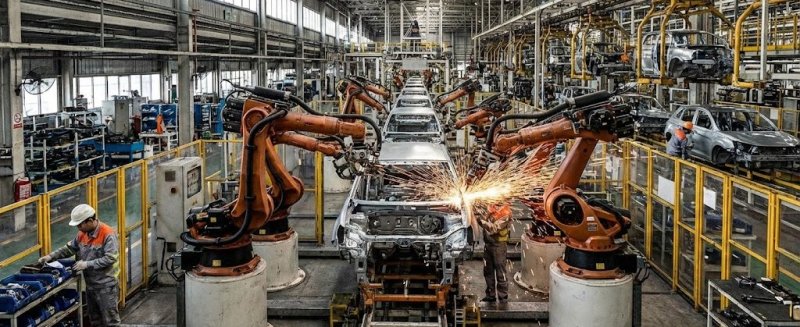
The main machine classes in automotive production lines are categorized as body manufacturing, assembly, surface-processing, material-handling and testing equipment. This classification regulates production flow, simplifies maintenance planning and strengthens specialization. According to current industrial automation studies, more than 70% of the workload in automotive factories is handled by robotic systems, particularly in body shops. This distinction directly influences the plant’s annual production capacity and model diversity.
As technology evolves, the boundaries between machine classes become more flexible. Quality-control machines, for example, no longer only measure; they can generate fault predictions through machine learning. Assembly robots do more than apply torque; they use sensor feedback to perform real-time precision calibration. As a result, each station contributes multidimensional value to the entire production ecosystem.
The machine infrastructure used in body manufacturing forms the most complex metal-forming network in the automotive industry. Press lines can transform a steel coil into a body panel in seconds, with press tonnage typically ranging between 600 and 2500 tons. Robotic welding cells perform thousands of spot welds with micrometric accuracy. In particular, servo presses consume up to 30% less energy than traditional hydraulic models.
Key systems in this stage include:
- Servo mechanical presses
- Transfer press lines
- Spot-welding robots
- Laser-welding and cutting machines
- Panel-measurement systems
Tolerances in the body shop are extremely strict. Even a 1 mm alignment error can lead to wind noise from door gaps and may reduce a vehicle’s safety rating.
Machines operating on assembly lines are built around principles of ergonomics, precision and repeatability. Bolt-tightening robots, for example, work with ±0.5 Nm accuracy in lower engine connections. This level of precision cannot be achieved through manual applications.
Prominent assembly systems include:
- Torque-controlled fastening robots
- Engine-to-transmission marriage systems
- Automatic glass-bonding robots
- Seat-assembly cells
- Wire-harness placement machines
Because these machines directly affect vehicle functionality, quality-assurance departments continuously monitor their data.
Paint shops are among the most energy-intensive areas of automotive factories. An average paint shop can account for 40% of a plant’s total energy consumption. Therefore, paint robots, air-circulation systems and curing ovens are designed around high-efficiency criteria.
Paint-shop machine groups include:
- Phosphate and electrocoat lines
- Powder and wet-paint robots
- Curing tunnels
- Surface-roughness measurement stations
Modern paint shops employ sensor-based spraying algorithms that generate hundreds of data points per second. This improves paint material efficiency by up to 20% while reducing VOC emissions.
Material flow is as critical as machine performance. A disruption in material supply can halt the entire line. For this reason, AGV (Automated Guided Vehicle) and AMR (Autonomous Mobile Robot) systems have become widespread.
Intralogistics machines include:
- Autonomous transport robots
- Conveyor lines
- Vertical storage systems
- Palletizing robots
Recent studies show that fully integrated AMR usage can reduce production waiting time by 27%, demonstrating the critical importance of material handling in manufacturing flow.
Automotive production line machines operate through sensor-based feedback, real-time control algorithms and robotic motion systems. The core principle is to achieve micro-level precision and macro-level coordination across all components.
The logic of machine operation consists of three layers:
- Mechanical function:<span> </span>Press force application, robot-arm motion.
- Electronic control:<span> </span>Motor drives, PLC outputs, servo control.
- Software and data:<span> </span>HMI interfaces, sensor analytics, fault prediction.
For efficient line performance, these three structures must work in harmony. For instance, if a torque robot detects abnormal resistance during tightening, it stops the process and sends an error code to the operator, preventing safety risks caused by loose joints.
Sensors act as the sensory organs of modern automotive machines. Pressure, vibration, temperature, torque and alignment sensors generate real-time data. LIDAR and 3D camera systems give robots environmental awareness.
Examples of sensor contributions:
- Laser-distance sensors providing ±0.05 mm alignment precision
- More than 90% defect-detection success with image-processing algorithms
- Thermal sensors controlling heat distribution at weld spots
These sensors enable predictive-maintenance algorithms that reduce unplanned downtime.
Machine performance is not solely determined by mechanical quality; it also depends on the accuracy and adaptability of its control software. In modern robotics, motion-optimization software can reduce cycle times by 10–20%.
PLC and SCADA systems allow operators to observe machine status in real time and intervene when necessary. Data-collection modules analyze machine-performance history to detect quality trends.
When coordination between robots and machines is disrupted, production flow is interrupted. Therefore, stations communicate via high-speed industrial networks such as EtherCAT, Profinet or Ethernet/IP.
Examples of coordination:
- Robots taking parts directly from press lines
- Paint robots adjusting spray patterns according to vehicle speed
- Assembly robots moving in sync with the conveyor
Every coordination cycle increases efficiency and precision.
Machine selection is based on production capacity, precision level, energy efficiency, maintenance ease and adaptability. The most important criterion is long-term compatibility with the plant’s production strategy. A machine may appear fast in the short term but can reduce overall efficiency if it cannot adapt to increased model diversity.
On average, automotive factories allocate about 60% of their investment budget to machine infrastructure, making selection decisions highly consequential.
A machine’s value is largely determined by its cycle time. For example, if a welding robot has a 15-second cycle time, it can perform about 240 operations per hour. Factory capacity is planned using such data.
Cycle-time calculations include:
- Motion sequence planning
- Part-feeding speed
- Intermediate process durations
- Sensor-validation periods
Without these calculations, line balancing cannot be achieved.
Precision levels are directly related to vehicle safety. Metrics such as weld integrity, torque values and measurement tolerances are critical in machine selection. Tests show that chassis-weld differences can create up to 15% variation in structural strength.
Key quality-control machine criteria:
- 3D-scanning resolution
- Measurement speed
- Algorithmic defect-detection capability
- Data-interface compatibility
Sustainability standards strongly influence machine selection. Servo presses consume 20–30% less energy than hydraulic equivalents, demonstrating why adoption is increasing.
Energy criteria include:
- Motor efficiency
- Heat-recovery capability
- Air-consumption levels
- Waste-management compliance
As model variety increases, machine flexibility becomes essential. Quick-changeover mechanisms, modular part-handling tools and adaptive software capabilities form the basis of this flexibility.