The growing demand for special purpose machinery in the automotive sector is driven by increasing product complexity and customization. Electric vehicles, lightweight materials, and modular platforms push the limits of conventional machines.
When manufacturers need to produce multiple models on the same line, flexibility and reconfigurability become essential. Custom-built machines provide this adaptability while significantly reducing downtime.
Modern automotive brands aim to introduce more models to the market in shorter timeframes. This requires rapid changeovers and minimal setup time. Special purpose machines can reduce line changeover times by up to 30 percent.
Tolerances in automotive manufacturing have reached micron levels. Even minor errors in welding, assembly, or measurement can result in costly recalls. Special machines maintain strict process control and minimize quality deviations.
Unlike conventional machine building, automotive special machinery manufacturing requires a multidisciplinary engineering approach. Mechanical, electrical, software, and automation teams work in parallel.
The process begins with a detailed analysis of the production line. Part geometry, cycle time, operator interaction, and quality requirements are clearly defined. Based on these inputs, a tailored machine concept is developed.
Three-dimensional CAD designs and digital twin simulations allow machines to be tested before physical production. Cycle time, collision risks, and ergonomic factors are validated at this stage.
Components are produced on high-precision CNC machines according to approved designs. During assembly, each subsystem is individually tested to prevent integration issues.
After integration into the production line, the machine undergoes a comprehensive validation process. Capacity, repeatability, and quality criteria are measured. In automotive projects, this phase accounts for nearly 20 percent of the total project duration.
Automotive special machinery manufacturing covers a wide range of equipment, each designed for a specific production operation.
Assembly machines designed for screw tightening, pressing, clipping, and bonding operations minimize human error. Torque-controlled systems ensure consistent quality for every part.
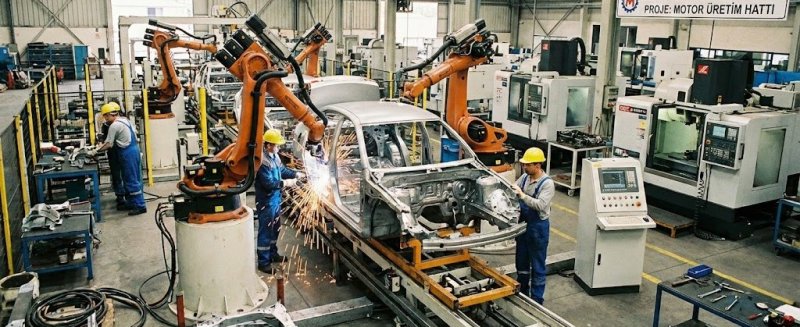
Spot welding, laser welding, and structural bonding systems form the backbone of automotive body production. Special machines enable safe and repeatable joining of different materials.
Functional testing, leak testing, and dimensional inspection systems are integral to production lines. These machines prevent defective parts from progressing further in the process.
Automation lies at the heart of automotive special machinery manufacturing. PLC-based control systems, robotic integration, and vision inspection solutions make production more predictable and stable.
With Industry 4.0 applications, machines collect and analyze production data in real time. This data supports maintenance planning, quality improvement, and process optimization.
More than 60 percent of industrial robots used in the automotive sector operate in welding and assembly applications. Special machines are designed to integrate seamlessly with these robots.
Through sensors and intelligent software, machines continuously monitor their own performance. This approach reduces unplanned downtime by approximately 15 to 20 percent.
Special purpose machinery provides not only technical but also strategic advantages for automotive manufacturers. A well-designed machine can deliver consistent quality and speed for many years.